
Call Now · (480) 717-9018
Serving Gilbert, Mesa & Chandler  |  ★ 4.9 Google Rating · 135 Reviews  |  (480) 717-9018
Home > Blog > Pool Automation Guide
Pool Automation Guide

A Seasonal Guide to Pool Automation in Gilbert AZ

Changelog: Updated for summer variable-speed scheduling, monsoon storm automation triggers, freeze protection configurations, and Wi-Fi motherboard diagnostics in Gilbert, AZ.
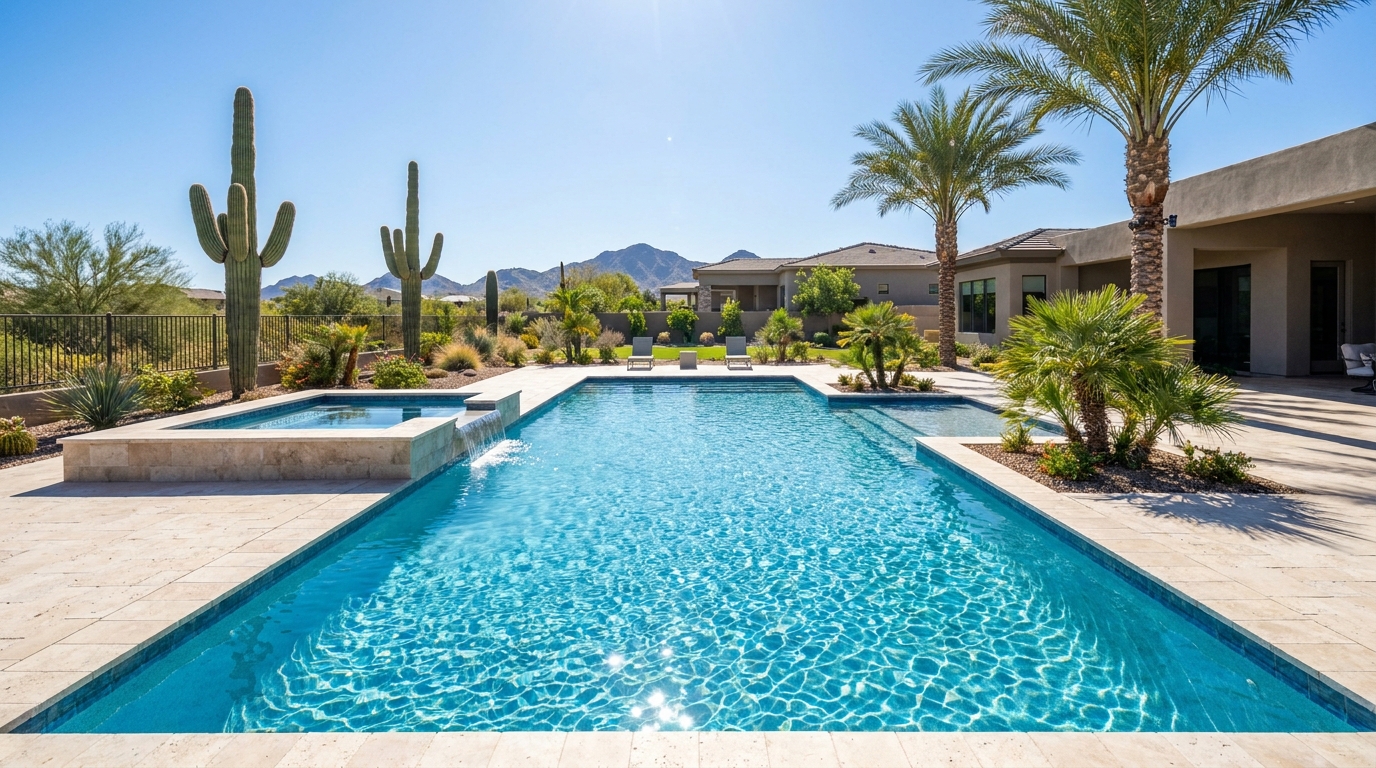
Gilbert AZ swimming pool smart automation panel and automated valve actuators undergoing seasonal maintenance
Maintaining optimal efficiency with smart pool automation in Gilbert, AZ requires seasonal schedule adjustments, sensor calibration, and surge protection.
Quick Answer

In Gilbert, AZ, pool automation controls must shift across seasons: program pump speeds for 10–12 hours off-peak during summer, calibrate automated valve actuators for water features, and ensure freeze protection overrides are set to 36°F to 38°F for cold winter nights. Routine sensor calibration, surge protection checks, and antenna maintenance prevent system lockouts and lower utility bills.

Seasonal Pool Automation Settings in Gilbert, AZ: The Annual Operating Guide

Modern smart pool automation systems (such as Pentair IntelliCenter, Jandy AquaLink, and Hayward OmniLogic) make controlling pumps, heaters, lighting, and sanitizers effortless. However, operating automated pool pads in Gilbert, AZ requires regular seasonal schedule shifts to handle extreme summer heat, monsoon electrical surges, and cold winter nights.

Failing to adjust speed presets, valve actuator schedules, and temperature sensors as the weather changes causes unnecessary power consumption, missed chemical generation windows, and freeze damage to above-ground plumbing.

Season Temp & Weather Automation Focus Field Realities in Gilbert, AZ
Spring March – May Recalibration Phase 75°F – 90°F
Mild conditions
Sensor & Actuator Checks Inspect automated 24V valve actuators for smooth turning, calibrate water and solar temperature thermistors, and adjust schedules for daylight saving time.
Summer Peak June – August Heavy Duty 105°F – 118°F
Extreme sun & heat
Off-Peak Utility Sync Configure variable-speed pump automation to run high speeds during early morning/evening off-peak utility hours. Ensure chlorinator relays match filtration runtimes.
Monsoon July – Sept Storm Management Dust storms, wind,
lightning surges
Surge & High-Clean Presets Program a dedicated "Storm Cleanup" speed preset to maximize skimmer suction after haboobs. Inspect equipment pad surge protectors and verify outdoor Wi-Fi antenna seals.
Fall & Winter October – Feb Reduced Cycle 40°F – 70°F
Crisp desert nights
Freeze Protection Calibration Verify automated freeze protection triggers when ambient air reaches 36°F–38°F, automatically engaging circulation pumps to protect exposed PVC pipes and valves.

Aligning your automation schedules and safety sensors with Gilbert’s climate helps you save on seasonal energy bills, extend equipment lifespan, and enjoy hassle-free app control year-round.

What Happens When Pool Automation Fails During a Desert Weather Shift

When unseasonable freeze warnings hit Gilbert in January, pool owners depend entirely on their automation system’s automated freeze protection. If an air temperature sensor is out of calibration or an auxiliary pump relay fails, water in above-ground manifolds can freeze solid within hours, cracking expensive valves, filters, and chlorinator cells.

Pool automation panel diagnostics and sensor wiring in Gilbert AZ
Field Service · Gilbert, AZ (Smart Automation Diagnostic) Valley Pool Service technician troubleshooting an automation mainboard communication fault. High summer sun had warped an unshielded Wi-Fi receiver housing, dropping remote connectivity. Replacing the outdoor antenna transceiver and recalibrating system thermistors restored full app management.

Case in Point: Resolving Freeze Protection Relay Failure in Morrison Ranch, Gilbert

A homeowner in Morrison Ranch noticed their pool pump was not turning on automatically during a 31°F winter morning freeze alert. Our inspection revealed that the 10k-ohm air temperature sensor had drifted by 14 degrees, reading the ambient air at 45°F instead of freezing. Our technician replaced the faulty thermistor probe, tested the high-voltage auxiliary relay contacts, and recalibrated the freeze override cycle to run the variable-speed pump at 1,800 RPM whenever temps drop below 37°F.

Explore More Real Arizona Pool Automation Projects →

Pool Automation & Electrical Safety Standards for Desert Systems

Installing and maintaining pool automation control centers in Gilbert, AZ requires adhering to guidelines set by the Pool & Hot Tub Alliance (PHTA ANSI/APSP-15) and National Electrical Code (NEC Article 680) standards.

Standard Operating Metrics for Residential Pool Automation Panels
Freeze Guard Trigger
36°F – 38°F
Panel Supply Voltage
120V / 240V Input
Low-Voltage Actuators
24V AC Output
Data Bus Protocol
RS-485 Shielded
Auxiliary Relays
3 HP Rated (30A)
Bonding Grid Wire
#8 AWG Solid Copper

Ensuring accurate voltage regulation, isolated high- and low-voltage channels, and equipotential ground bonding safeguards sensitive motherboard microprocessors against summer lightning spikes and protects swimmers from electrical hazards.

When DIY Pool Automation Repair Is the Wrong Choice in Gilbert

Honest Advice: When You Should Not Attempt DIY Automation Work
  • Rewiring 240V high-voltage subpanel relays: Servicing line-voltage contactor relays or transformer step-downs without strict circuit lockouts exposes homeowners to dangerous electrical hazards.
  • Adjusting internal valve actuator microswitches blindly: Incorrectly setting cam stop limits inside a 24V motorized valve actuator can dead-head the pump against closed lines, blowing apart PVC pipes.
  • Cross-connecting low-voltage and high-voltage channels: Accidental contact between 120V/240V lines and the low-voltage RS-485 data bus instantly fries motherboard processors and variable-speed communication drives.
  • Bypassing freeze protection routines to save power: Manually disabling automated freeze guard logic during cold desert nights can cause water inside above-ground equipment to freeze and rupture filter tanks and chlorinator bodies.

Frequently Asked Questions About Pool Automation in Gilbert AZ

Direct Arizona sun exposure on outdoor plastic Wi-Fi antenna modules can cause internal microchips to overheat, leading to intermittent disconnects. Adding a small sun shield over the antenna or relocating the transceiver to a shaded area with a dedicated 2.4 GHz signal extender typically resolves the issue.
Freeze protection is controlled by an external ambient air temperature sensor. When temperatures drop below 36°F to 38°F, the automation panel overrides standard timers and turns on filtration pumps and waterfall valves at a preset speed. Moving water prevents ice crystals from forming inside exposed plumbing manifolds and filter tanks.
Yes. Modern retrofit automation systems (such as Pentair IntelliConnect or Hayward OmniHub) can be installed on existing equipment pads. Adding high-voltage relays controls standard pumps, while motorized 24V valve actuators replace manual valve handles, allowing full mobile app control.
Valve actuators have a 3-position toggle switch underneath (ON 1 / OFF / ON 2) that sets the rotational direction. If the valve stops mid-turn or chatters, the internal microswitches or cam stops may have slipped, or the internal nylon reduction gears may be stripped from turning against a stiff valve diverter.
Jason Miller, Lead Pool Technician at Valley Pool Service
Article Author & Lead Technician

Jason Miller

Jason is the Lead Pool Technician and Certified Pool Operator (CPO® #582194) at Valley Pool Service, with over 12 years of hands-on Arizona pool maintenance and equipment troubleshooting experience. Having overseen route care for more than 1,000 East Valley pools across Gilbert, Mesa, and Chandler, he specializes in high-temperature water chemistry stabilization, variable-speed hydraulics, and seasonal route care.

Learn more about our certified technicians →

Want an Honest Assessment of Your Pool's Chemistry?

Send us a photo of your pool and equipment pad or give us a quick call. Our certified technicians will evaluate your chemical balance, check filtration efficiency, and recommend a personalized plan for year-round clarity.

Get My Free Estimate Call (480) 717-9018