Call Now · (480) 717-9018
Serving Gilbert, Mesa & Chandler  |  ★ 4.9 Google Rating · 135 Reviews  |  (480) 717-9018
Home > Blog > Seasonal Maintenance Blueprint
Seasonal Maintenance Blueprint

How Do You Maintain a Swimming Pool in Arizona Year-Round? (Seasonal Maintenance Blueprint)

Changelog: Updated for post-monsoon recovery protocols, fall filtration schedule adjustments, and cyanuric acid (CYA) lock prevention in high-heat desert zones.
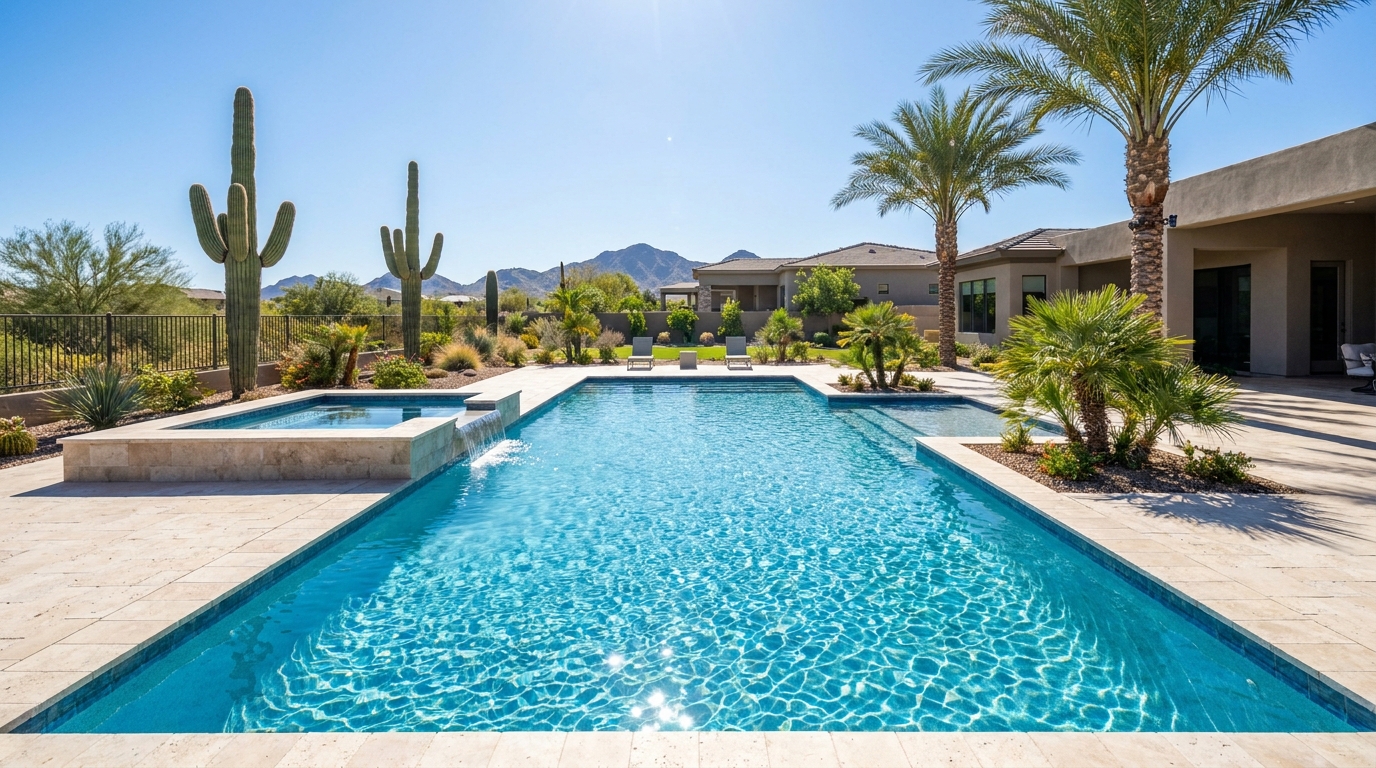
Arizona backyard swimming pool operating year-round with clear water against desert climate
Maintaining crystal-clear pool water in the Sonoran Desert requires distinct seasonal adjustments rather than traditional winter shutdowns.
Quick Answer

In Arizona, swimming pools stay open 365 days a year without traditional winterizing; maintenance instead pivots by season: run single-speed pumps 10 to 12 hours daily in summer (when water temperatures exceed 90°F and unbuffered chlorine burns off in 45 minutes) versus 4 to 6 hours in winter. Maintain cyanuric acid stabilizer strictly at 40 to 60 ppm, test water chemistry twice weekly from June through September, and chemically degrease cartridge filters after major monsoon haboobs to maintain system pressure and guarantee an algae-free pool.

Arizona 4-Season Pool Care: The Desert Operating Guide

In most parts of the country, pool owners winterize their equipment in October, cover the water, and reopen in May. In the Phoenix East Valley — covering Mesa, Gilbert, Chandler, and Queen Creek — swimming pools remain full, filtered, and chemically active every day of the year.

However, operating an open pool through 115°F summer heatwaves, violent monsoon dust storms (haboobs), and 40°F desert winter nights requires seasonal protocol shifts. Failing to adjust daily filtration runtimes and sanitizer ratios as the seasons change results in rapid algae blooms, calcium scale deposits, and premature pump motor burnout.

Season Temp & Weather Daily Runtime Field Realities in the East Valley
Spring March – May Prep Period 75°F – 90°F
Pollen & blossoms
8 Hours Rising water temperatures wake dormant algae spores. Clean cartridge filters, lubricate pump lid O-rings, and verify salt cell output before summer heat strikes.
Summer Peak June – August Highest Demand 105°F – 118°F
Water 90°F+
10 – 12 Hours Intense UV degrades unbuffered chlorine in 45 minutes. Free chlorine demand doubles. Schedule pumping during off-peak morning and evening hours; test water twice weekly.
Monsoon July – Sept Storm Watch Dust storms, wind,
sudden rain bursts
12 Hours (Continuous) Haboob winds dump pounds of organic dust into skimmers, spiking phosphates above 500 ppb. Requires immediate debris removal, filter degreasing, and chemical shock.
Fall & Winter October – Feb Reduced Cycle 45°F – 70°F
Chilly water
4 – 6 Hours Algae growth decelerates dramatically in water below 60°F. Reduce pump hours to conserve energy. Note: salt chlorine generators automatically shut off below 52°F water temp.

By aligning your pump timer and chemical dosage to these four distinct desert phases, you protect your pool plaster from mineral pitting, cut summer power bills, and guarantee your pool is ready for a swim whenever warm weather arrives.

What Happens When a Pool Skips Seasonal Post-Monsoon Protocol

During July and August, haboob dust storms sweep through Mesa and the East Valley with winds exceeding 50 MPH. Homeowners often wake up to find their crystal-clear pool transformed into a murky brown reservoir. The biggest mistake we see is simply shocking the water and walking away.

Filter clean before and after during monsoon season recovery in Mesa AZ
Field Recovery · Mesa, AZ (Ambient Temp: 108°F) Valley Pool Service crew mid-recovery following a July haboob storm. Filter canister pressure had surged from an operating baseline of 14 PSI to 34 PSI, choking water flow to 22 GPM. Complete chemical degreasing removed over 9 lbs of fine desert caliche silt, restoring flow rate back to the manufacturer-rated 64 GPM.

Case in Point: Resolving Severe Chlorine Lock in Eastmark, Mesa

A homeowner in Eastmark was adding multiple pounds of granular shock each week, yet free chlorine remained at 0.0 ppm while algae spread across the tile line. Our water analysis revealed cyanuric acid had climbed to 125 ppm from years of trichlor puck accumulation. Rather than draining the pool down to dry plaster in 112°F heat — which risks delamination — our crew performed a partial 40% drain-and-refill, introduced liquid sodium hypochlorite, and cleaned the clogged filtration cartridges. The pool regained 100% clarity within 36 hours.

Explore More Real Arizona Pool Transformations →

What Water Safety Standards Require for Desert Swimming Pools

Maintaining balanced pool chemistry in Arizona is governed by strict water safety guidelines established by the U.S. Environmental Protection Agency (EPA) and the Pool & Hot Tub Alliance (PHTA ANSI/APSP-11) standards.

Standard Chemistry Tolerances for Arizona Residential Pools
Free Chlorine
2.0 – 4.0 ppm
pH Level
7.4 – 7.6
Total Alkalinity
80 – 120 ppm
Cyanuric Acid (CYA)
40 – 60 ppm
Calcium Hardness
200 – 400 ppm
Phosphates
< 100 ppb

In desert environments where water temperatures rise into the 90s, chlorine becomes slightly less active while algae reproduces exponentially faster. Maintaining your water within these scientifically verified parameters ensures sanitation while protecting expensive copper heat exchangers, pump impellers, and plaster surfaces from aggressive mineral corrosion.

When DIY Pool Maintenance Is the Wrong Move in Arizona

Honest Advice: When You Should Not Tackle Pool Issues Alone
  • Recovering from severe cyanuric acid lock: If testing reveals stabilizer above 90–100 ppm, continuing to dump chlorine shock into the water is throwing money away. The water must undergo a calculated dilution with fresh municipal water.
  • Draining your pool during summer months: Draining a plaster or pebble-sheen pool when ambient temperatures exceed 85°F causes rapid dehydration and thermal expansion. Plaster can spiderweb, bubble, or lift off the shell within hours of direct desert sun exposure.
  • DIY acid washing older or delicate plaster: Over-concentrated muriatic acid can strip the protective cream coat down to exposed aggregate and sand, causing rough texture and permanent hydration staining.
  • Electrical troubleshooting on 230V equipment: Variable-speed drive inverters, bonding grids, and high-voltage pool subpanels require licensed diagnostic tools and precautions to prevent severe electrical hazards.

Frequently Asked Questions About Arizona Seasonal Pool Care

When ambient temperatures exceed 110°F and water warms past 90°F, chemical reactions speed up dramatically. Unbuffered free chlorine can burn off in less than 45 minutes under direct desert sun. If cyanuric acid is too low or sanitizer levels dip even slightly, single-cell green or mustard algae spores can reproduce into millions of visible colonies within two days.
Never drain a plaster or pebble pool when temperatures exceed 85°F. Direct desert sun and high heat cause plaster to dry out and expand unevenly, leading to spiderweb cracking, surface popping, and costly re-plastering repairs. If chemical levels require water renewal, schedule partial drain-and-refill cycles or wait until the cooler months between November and March.
Almost all residential salt chlorinators (including Pentair, Hayward, and Jandy) have a built-in cold-water protection cutoff that shuts down electrolytic chlorine generation when water temperatures drop below 50°F to 52°F. In East Valley winters, homeowners must supplement with liquid chlorine (sodium hypochlorite) until water warms back up in the spring.
Due to intense evaporation and high natural mineral content in Arizona tap water, Total Dissolved Solids (TDS) and calcium hardness steadily climb. Most East Valley residential pools require a partial or complete water replacement every 2 to 3 years once calcium hardness exceeds 800 ppm or TDS surpasses 2,500 ppm, which prevents waterline scale and equipment calcification.
Jason Miller, Lead Pool Technician at Valley Pool Service
Article Author & Lead Technician

Jason Miller

Jason is the Lead Pool Technician and Certified Pool Operator (CPO® #582194) at Valley Pool Service, with over 12 years of hands-on Arizona pool maintenance and equipment troubleshooting experience. Having overseen route care for more than 1,000 East Valley pools across Gilbert, Mesa, and Chandler, he specializes in high-temperature water chemistry stabilization, variable-speed hydraulics, and seasonal route care.

Learn more about our certified technicians →

Want an Honest Assessment of Your Pool's Chemistry?

Send us a photo of your pool and equipment pad or give us a quick call. Our certified technicians will evaluate your chemical balance, check filtration efficiency, and recommend a personalized plan for year-round clarity.

Get My Free Estimate Call (480) 717-9018